
About this page
The Pol Star System is the primary cradle and operational center of Denebolian civilization and the administrative core of the Denebolian Accord Alliance. Organized around the stable G-type star known as Pol Star.
Of the system's eight recognized major bodies, only three support permanent habitation, selected not by chance but through environmental assessment and strategic necessity.

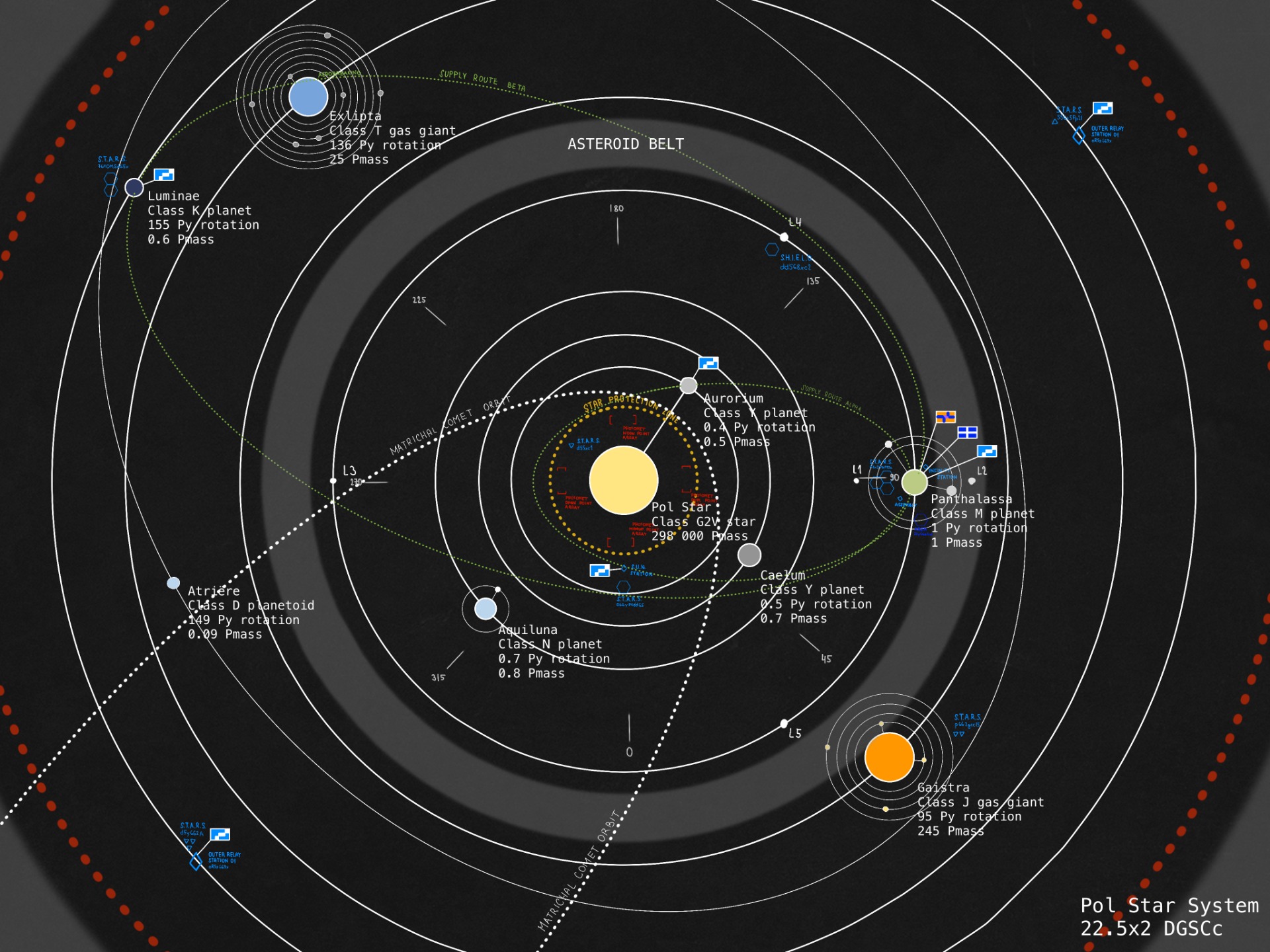
Pol Star system - navigational charts
Detailed orbital overview of the local stellar system centered on Pol Star. It illustrates the relative positions, orbital paths, and classifications of all major planets, the dwarf planetoid Atrière, asteroid belts, and permanent artificial installations.
The chart is primarily used for navigation, system traffic coordination, and administrative reference, and reflects standardized Denebolian astronomical measurements.
Galactic Interstellar navigational charts
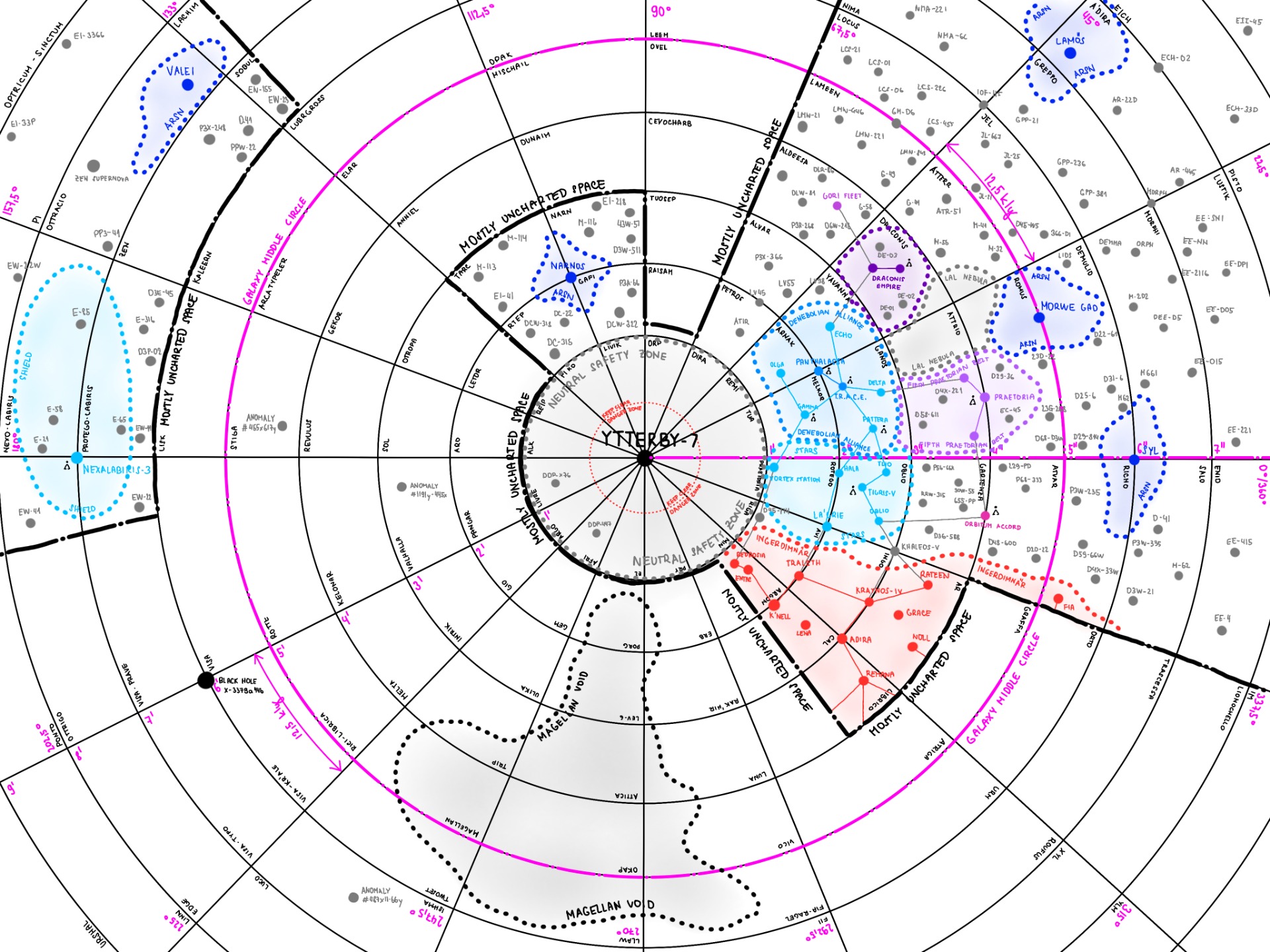
The galactic chart situates the Pol Star System within the broader known galaxy, mapping surrounding regions, political spheres of influence, uncharted space, and major navigational routes.
This chart serves as a strategic and geopolitical reference, supporting long-range planning, diplomacy, and interstellar navigation rather than precise stellar-scale measurements.
The following list of celestial bodies is ordered according to their mean orbital distance from Pol Star, beginning with the innermost object and proceeding outward to the furthest body within the system. This ordering reflects standardized Denebolian astronomical classification and is used for navigation, cartography, and administrative reference.
Each entry below provides standardized astronomical and administrative information for the listed celestial body. This includes its physical classification, orbital parameters, mass and gravity references, atmospheric composition where applicable, known moons or ring systems, habitability status, and any officially designated political, scientific, or strategic function within the Pol Star System.

Pol Star
G2V Main-sequence star
Key Info
Mass: ~ 298 000 Pmass
Avg surface temp.: ~ 5 427 C
Luminosity: Stable G-type
Primary role: central stellar anchor
Artificial structures: S.U.N. Observation station in orbit
Overview
Pol Star is a stable G-type main-sequence star and the central stellar body of the Pol Star System. Its predictable radiation output and low stellar volatility have enabled long-term orbital stability, making it suitable for sustained habitation, interplanetary infrastructure, and large-scale political organization.
From a Denebolian scientific perspective, Pol Star is classified as an optimal stellar environment and serves as the primary gravitational, navigational, and temporal reference for the entire system.

Aurorium (Melkor)
Class Y planet
Key info
Orbit: 1st
Orbital period: 0,4 Py
Mass: 0,5 Pmass
Gravity: ~ 0,7 PG
Avg surface temp.: ~ 740 C
Atmosphere: Toxic, SO2-SO2 dominant
Habitability: Non-habitable (artificial only)
Administrative control: Denebolian Accord
Overview
Aurorium is a volcanically active inner-system planet orbiting close to Pol Star. Characterized by extreme surface temperatures, constant tectonic instability, and a highly toxic atmosphere, the planet is naturally hostile to biological life. These conditions have made Aurorium unsuitable for civilian habitation but strategically valuable for controlled, high-security purposes.
From a Denebolian administrative standpoint, Aurorium functions as an international prison world, hosting detention facilities for individuals classified as high-risk by Accord authorities. Its environmental lethality provides a natural containment layer that significantly reduces escape feasibility and operational overhead.

Caelum
Class Y planet
Key info
Orbit: 2nd
Orbital period: 0,5 Py
Mass: 0,7 Pmass
Gravity: ~ 0,9 PG
Avg surface temp.: ~ 480 C
Atmosphere: Toxic, Dense CO2 with sulfuric aerosols
Habitability: Non-habitable
Administrative control: Denebolian Accord
Overview
Its atmosphere is dominated by carbon dioxide and sulfuric compounds, producing extreme greenhouse conditions and surface pressures approaching ninety times that of Panthalassa. Average surface temperatures remain near 480 °C, making the planet lethal to all known forms of life and machinery not specifically hardened for extreme environments.
Caelum's hostility is atmospheric rather than geological. Severe turbulence within its cloud layers prevents the construction of stable orbital or atmospheric habitats, and surface operations are limited to short-duration automated probes.

Aquiluna
Class N planet
Key info
Orbit: 3rd
Orbital period: 0,7 Py
Mass: 0,8 Pmass
Gravity: ~ 0,9 PG
Avg surface temp.: ~ -100 C
Atmosphere: Dense N2-CH4 with CO2 traces
Habitability: Non-habitable (theoretical subsurface potential)
Administrative control: Denebolian Accord
Moons: (1) Nalu
Overview
The planet is characterized by a dense atmosphere and a highly reflective surface composed primarily of ice-covered global oceans. Due to its high albedo Aquiluna retains little solar heat, resulting in an average surface temperature of approximately –100 °C.
Geological and magnetic data strongly suggest the presence of liquid water beneath its ice crust, maintained by internal heat and tidal interactions with its moon, Nalu. While no direct evidence of life has been observed, Aquiluna is considered one of the most promising candidates in the Pol Star System for theoretical subsurface biospheres, and remains under continuous long-term observation by Denebolian research institutions.

Panthalassa (Yavanna)
Class M planet
Key info
Orbit: 4th
Orbital period: 1 Py
Mass: 1 Pmass
Gravity: ~ 1 PG
Avg surface temp.: ~ 18 C
Atmosphere: N2-O2 dominant, breathable
Habitability: Fully habitable
Administrative control: Capital world of Denebolian Accord Alliance
Moons: (2) Thalor, Lone
Overview
With a stable climate, breathable atmosphere, and extensive hydrosphere, the planet supports a large and technologically advanced population distributed across continental landmasses, archipelagos, and artificial oceanic structures. Its average surface temperature of approximately 18 °C allows for long-term ecological stability and agricultural sustainability.
Panthal hosts the Accord's primary governing institutions, major interplanetary trade hubs, and command-level STARS infrastructure. The presence of two moons, Thalor and Ione, generates strong but predictable tidal forces that influence both oceanic circulation and planetary climate. Panthal's orbital space is densely developed, reflecting its role as the central node of civilization within the Pol Star System.

Gaistra
Class J Gas giant
Key info
Orbit: 5th
Orbital period: 95 Py
Mass: 245 Pmass
Gravity: ~ 2,4 PG (upper atmosphere)
Avg surface temp.: ~ -140 C
Atmosphere: H2-He dominant with amonia traces
Habitability: Non-habitable
Administrative control: Denebolian Accord
Moons: (4) Eryth, Kalyx, Myra, Solen
Overview
Gaistra is the largest planetary body in the Pol Star System and occupies the fifth orbit around Pol Star. It is a massive gas giant characterized by bright cloud bands, intense auroral activity, and a powerful magnetosphere. Although uninhabitable, Gaistra plays a major visual and gravitational role within the system and is the fourth brightest object visible from Panthalassa's surface.
Several of Gaistra's moons exhibit conditions that warrant long-term study, including subsurface oceans and geothermal activity. In addition, the planet is encircled by a dense asteroid ring composed of rocky and metallic debris, believed to be the remnants of a failed moon formation event. These features make Gaistra a priority target for future scientific and industrial expansion.

Exlipta
Class T Gas giant
Key info
Orbit: 6th
Orbital period: 136 Py
Mass: 125 Pmass
Gravity: ~ 1,8 PG (upper atmosphere)
Avg surface temp.: ~ -160 C
Atmosphere: H2, rich with sulfur and rare exotic gases
Habitability: Non-habitable
Administrative control: Denebolian Accord
Moons: (7) Rhex, Vael, Tyr, Ophra, Nym, Caer, Loth
Overview
Exlipta is an outer-system gas giant defined by extreme atmospheric instability and persistent planet-scale storm systems. Its atmosphere contains significant concentrations of rare gases and exotic compounds of high theoretical industrial value. However, the planet's violent weather patterns, electromagnetic interference, and unpredictable pressure gradients have rendered all extraction attempts unsuccessful.
Exlipta is surrounded by a chaotic asteroid ring composed of captured debris and fragmented moonlets. Combined with its seven unstable moons, this environment makes the planet one of the most hostile locations in the Pol Star System. As a result, Exlipta remains classified as a high-risk observation and research target rather than an active industrial asset.

Luminae (Irmo)
Class K planet
Key info
Orbit: 7th
Orbital period: 155 Py
Mass: 0,6 Pmass
Gravity: ~ 0,8 PG
Avg surface temp.: ~ -60 C
Atmosphere: Thin CO2-N2 mix
Habitability: Non-habitable (artificial only)
Administrative control: Denebolian Accord
Moons: (1) Astrae
Overview
Luminae is a cold, dimly lit rocky planet located at the outer edge of the Pol Star System. Due to its distance from Pol Star and thin atmosphere, the planet exists in a state of near-perpetual twilight, with surface temperatures averaging around –60 °C. Natural habitability is impossible without artificial support.
Luminae hosts a restricted SHIELD research outpost, dedicated to high-risk scientific projects that cannot be conducted safely elsewhere in the system. Its fragmented asteroid ring provides both a navigational hazard and a natural layer of signal interference, which is actively exploited for operational concealment.

Atrière
Class D dwarf planet
Key info
Orbit: Highly eccentric, inclined
Orbital period: 149 Py
Mass: 0,09 Pmass
Gravity: ~ 0,3 PG
Avg surface temp.: ~ -90 C
Atmosphere: None
Habitability: Non-habitable
Administrative control: Denebolian Accord
Overview
Small rocky planetoid with a highly inclined and eccentric orbit that periodically carries it across the orbital planes of multiple planets. For part of its orbit, Atrière becomes the most distant known object in the Pol Star System. Its surface is heavily cratered, with traces of ancient cryovolcanic activity and localized radiation anomalies.
Due to its unstable orbit and lack of immediate strategic value, Atrière remains under passive observation only. However, unexplained geometric surface features detected by orbital surveys have ensured continued scientific interest and classification as a protected body under Denebolian Accord regulations.

Matrichal Comet
Long-period comet
Key info
Orbit: Highly eccentric, inclined
Orbital period: ~ 310 Py (estimated)
Perihelion: Inside Aurorium's orbital region
Aphelion: Beyond Luminae's orbit
Nucleus diameter: ~ 18-24km (estimated)
Composition: Water ice, CO2 ice, silicates, complex organics
Habitability: Non-habitable
Administrative control: Monitored object
Overview
Long-period comet following a highly eccentric and inclined orbit that carries it through the inner and outer regions of the Pol Star System. Its trajectory intersects the orbital zones of multiple planets, including Aquiluna, Panthalassa, and Gaistra, before extending far beyond the orbit of Luminae. The comet's orbital inclination places it well outside the primary planetary plane.
During perihelion passage, when the comet approaches Pol Star, Matrichal Comet develops a pronounced dual tail composed of ionized gases and fine particulate dust. These events are visible from Panthalassa and have been recorded continuously since the early observation era. Spectroscopic analysis suggests the comet contains complex organic compounds alongside volatile ices, making it a valuable reference object for studying early system formation and primordial material retention.