
DOCUMENT 03 - MAP OF TRANSPORTATION DEVELOPMENT
Denebolian Ministry of Urban Development
Introduction
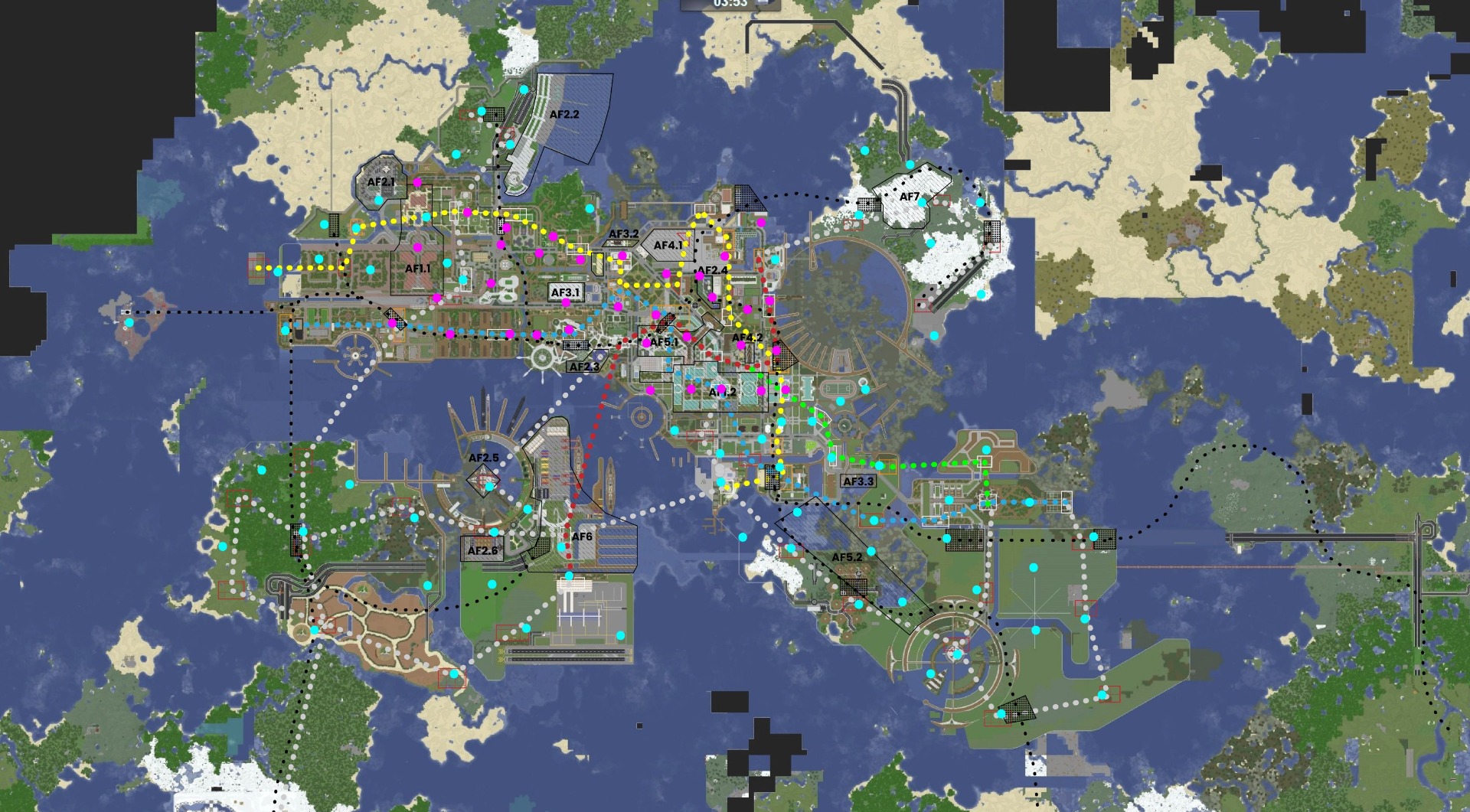
The Map of Transportation Development forms the third regulatory layer of the Denebol Prime Metropolitan Plan. It identifies the present and future transport network of the city, including subway corridors, maglev corridors, stations, transport points and no-fly zones.
The map should be read together with its regulatory description. The map defines the location and category of transport infrastructure, while the legal text explains the protection of corridors, station reserves, transport points and air-traffic restrictions.
The document protects existing infrastructure and reserves space for future connections. This is especially important in transformation areas, where new development must remain coordinated with future public transport, interchange points and strategic corridors.
No-fly zones form a separate regulatory layer within this document. They define where different types of air traffic are restricted or permitted, including civilian, military, government and international traffic. These restrictions protect sensitive infrastructure, strategic areas and selected parts of the city.
This document serves as a strategic transport framework. Later studies and infrastructure projects may refine technical alignments or station positions, but they must preserve the main transport function shown in the map.
Leave a message
Legal Attachment
Regulatory Description of Transport Corridors, Stations, Transport Points and No-Fly Zones
Article I. - Purpose of the Document
- The Map of Transportation Development forms the third regulatory layer of the Denebol Prime Metropolitan Plan.
- The purpose of this document is to identify existing and future transport infrastructure of metropolitan importance.
- This document defines present and future subway corridors, present and future maglev corridors, existing and future stations, stations intended for reconstruction, transport points and no-fly zones.
- The document provides the strategic framework for the protection, coordination and phased development of transport infrastructure across Denebol Prime.
- The document shall be used for the preparation of urban studies, infrastructure projects, district plans, public-space projects and future development decisions.
Article II. - Relation to the Metropolitan Plan
- This document shall be read together with the other documents of the Denebol Prime Metropolitan Plan.
- Where the Map of Transformations identifies areas of expected change, this document identifies the transport framework that shall support such change.
- Where the Map of Architectural Values protects architectural and landscape character, this document shall be applied in a manner that respects such protection while preserving the long-term functionality of transport corridors.
- In case of conflict between local development and a transport corridor identified by this document, the protection of the transport corridor shall prevail until a replacement alignment or equivalent solution is approved.
Article III. - Interpretation of the Map
- The Map of Transportation Development identifies transport elements through colour, line type, point markers and no-fly-zone codes.
- Present subway corridors are shown by coloured dotted lines, including blue, green, red and yellow corridors.
- Present maglev corridors are shown by black dotted lines.
- Future subway corridors are shown by gray dotted lines.
- Future maglev corridors are shown by black dotted lines where designated as future corridors.
- Present subway and maglev stations are shown by white squares.
- Future subway and maglev stations are shown by red squares.
- Maglev stations are shown by black squares.
- Existing stations intended for reconstruction are shown by orange squares.
- Present transport points are shown by violet points.
- Future transport points are shown by cyan points.
- No-fly zones are shown as black-bordered areas marked by codes beginning with the prefix "AF".
- The map determines the position and spatial relationship of transport elements. This text determines their regulatory meaning.
Article IV. - General Transport Development Principles
- Transport infrastructure shall be planned as a continuous metropolitan network.
- Future development shall not block, interrupt or make impossible the implementation of corridors, stations and transport points shown on the map.
- Corridors shown on the map are strategic alignments. Their exact technical position may be refined by later infrastructure documentation.
- Stations and transport points shall be integrated with surrounding public spaces, pedestrian routes, development areas and district centres.
- New development around stations shall support walkability, public-space quality and interchange between transport modes.
- Transport infrastructure shall be coordinated with landscape corridors, protected buildings and special-use areas.
- No-fly zones shall be respected in all air-traffic planning, military operations, government operations, international arrivals and civilian movement.
Article V. - Present Subway Corridors
Article VI. - Future Subway Corridors
Article VII. - Present MagLev Corridors
Article VIII. - Future MagLev Corridors
Article IX. - Present Stations
Article X. - Future Stations
Future stations are reserved locations for planned subway or maglev access. Future stations shall be protected in urban studies, transformation areas and district-level plans. Development around future stations shall allow later construction of entrances, platforms, technical facilities and interchange public spaces. A future station may be moved within the same general area if a later transport study proves a better technical or urban solution.
Article XI. - Stations Intended for Reconstruction
Article XII. - MagLev Stations
Article XIII. - Present Transport Points
Article XIV. - Future Transport Points
Article XV. - General Regulation of No-Fly Zones
Article XVI. - No-Fly Zones
AF1.x No-Fly Zones
- Include AF1.1 and AF1.2.
- Civilian traffic is not allowed in AF1.x zones.
- Military traffic is not allowed in AF1.x zones.
- International traffic is not allowed in AF1.x zones.
- Government traffic is allowed in AF1.x zones.
- Government traffic shall operate only where compatible with safety, security and the protected function of the area.
AF2.x No-Fly Zones
- Include AF2.1, AF2.2, AF2.3, AF2.4, AF2.5 and AF2.6.
- Civilian traffic is not allowed in AF2.x zones.
- International traffic is not allowed in AF2.x zones.
- Military and government traffic may be allowed unless restricted by a more specific operational decision.
- Any permitted traffic shall respect the strategic or sensitive character of the zone.
AF3.x No-Fly Zones
- Include AF3.1, AF3.2 and AF3.3.
- Military traffic is not allowed in AF3.x zones.
- Civilian traffic is not allowed in AF3.x zones.
- Government and international traffic may be allowed unless restricted by a more specific operational decision.
- Any permitted traffic shall respect safety, public-space use and the protected urban function of the area.
AF4.x No-Fly Zones
- Include AF4.1 and AF4.2.
- Civilian traffic is not allowed in AF4.x zones.
- Military traffic is not allowed in AF4.x zones.
- Government traffic is not allowed in AF4.x zones.
- International traffic may be allowed only where compatible with the purpose of the zone and subject to competent authority approval.
AF5.x No-Fly Zones
- Include AF5.1 and AF5.2.
- Civilian traffic is not allowed in AF5.x zones.
- Military, government and international traffic may be allowed unless restricted by a more specific operational decision.
- Any permitted traffic shall respect local safety and security requirements.
AF6 No-Fly Zone
- AF6 is a special no-fly zone.
- Military traffic is not allowed in AF6.
- Civilian, government and international traffic may be allowed unless restricted by a more specific operational decision.
- Any permitted traffic shall be coordinated with airport and transport infrastructure in the surrounding area.
AF7 No-Fly Zone
- AF7 is a special military-only air-traffic zone.
- Only military traffic is allowed in AF7.
- Civilian traffic is not allowed in AF7.
- Government traffic is not allowed in AF7 unless specifically authorized as part of a military operation.
- International traffic is not allowed in AF7 unless specifically authorized as part of a military or diplomatic-security operation.
- AF7 shall be treated as a restricted strategic zone.