
DOCUMENT 04 - MAP OF PUBLIC INSTITUTIONS
Denebolian Ministry of Urban Development
Introduction
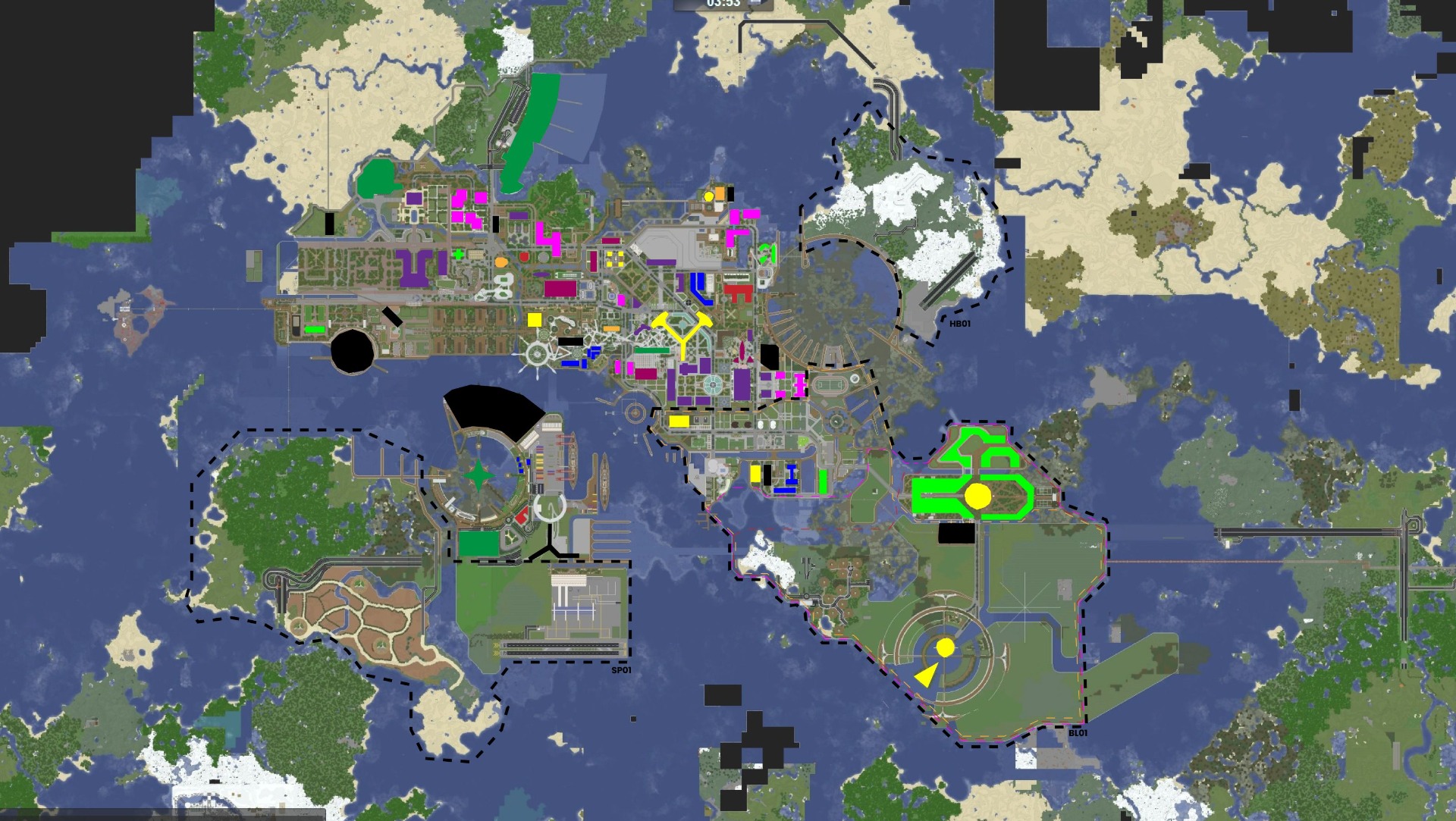
The Map of Public Institutions forms the fourth regulatory layer of the Denebol Prime Metropolitan Plan. It identifies existing public institutions and designated development areas where new institutional buildings must be included in future planning.
The map should be read together with its regulatory description. The map defines the location and category of existing public institutions, while the legal text explains how these institutions shall be protected, coordinated and expanded.
Public institutions are divided into several categories, including education, military, fire department, police, government, healthcare, diplomacy, culture, finance and transportation. Together, these buildings form the civic network of Denebol Prime.
The document also sets requirements for new institutional development in Borrowland, West Islands and Bay Horn. These territories are expected to accommodate major future growth, and their urban studies must therefore include public services from the beginning.
This document ensures that future development is not planned only as buildings, roads and districts, but also as a functioning capital city with public services, emergency coverage, representative institutions and civic infrastructure.
Leave a message
Legal attachment
Regulatory Description of Public Institutional Buildings and Development Areas
Article I. - Purpose of the Document
- The Map of Public Institutions forms the fourth regulatory layer of the Denebol Prime Metropolitan Plan.
- The purpose of this document is to identify existing public, strategic and civic institutions of metropolitan importance.
- This document also designates development areas where new public institutional buildings shall be included in future development.
- The document supports balanced distribution of public services, emergency response, government functions, education, healthcare, culture, diplomacy, finance, military infrastructure and transport-related public facilities.
- The document shall be used for the preparation of urban studies, transformation-area planning, infrastructure projects, district plans and public investment coordination.
Article II. - Relation to the Metropolitan Plan
- This document shall be read together with the other documents of the Denebol Prime Metropolitan Plan.
- Where the Map of Transformations identifies areas of future change, this document identifies public institutional requirements that shall be considered within such change.
- Where the Map of Architectural Values identifies protected buildings, this document identifies institutional function and public importance.
- Where the Map of Transportation Development identifies transport corridors and stations, this document shall support the placement of institutions in accessible locations.
- Public institutional buildings may also be subject to architectural protection, transport protection or no-fly-zone regulation under other documents of the Metropolitan Plan.
Article III. - Interpretation of the Map
The Map of Public Institutions identifies public institutional buildings by colour category.
- Light green markers identify education buildings.
- Dark green markers identify military buildings.
- Red markers identify fire department buildings.
- Blue markers identify Denebolian Police Force buildings.
- Purple markers identify government buildings.
- Pink markers identify hospitals and healthcare buildings.
- Bordeaux markers identify diplomatic buildings and embassies.
- Yellow markers identify culture buildings.
- Orange markers identify banks and financial public institutions.
- Black markers identify transportation buildings.
Development areas are identified by codes shown on the map. The map determines the location and category of public institutions and designated development areas. This text determines their regulatory meaning.
Article IV. - General Principles for Public Institutions
- Public institutional buildings shall be preserved as part of the metropolitan civic structure unless replaced by an equivalent or better facility.
- New development shall not remove or isolate existing public institutions without securing functional continuity.
- Public institutions shall be connected to public spaces, pedestrian routes and transport infrastructure where possible.
- New public institutions in development areas shall be planned as visible, accessible and integrated parts of the urban structure.
- Institutional buildings shall support the identity and service capacity of their surrounding district.
- Public institutions may be combined with other compatible functions where safety, security and public access allow it.
- Institutions with strategic, military, diplomatic, healthcare, emergency or transport function may require additional security or operational review.
Article V. - Categories of Public Institutional Buildings
Education Buildings
- Education buildings include schools, academies, universities, research facilities and other public learning institutions.
- Education buildings shall be protected as part of the long-term civic infrastructure of the city.
- New education buildings should be located near residential or mixed urban areas and shall be accessible by public transport and pedestrian routes.
- Development areas with significant residential or mixed-use growth shall consider the need for education capacity.
Military Buildings
- Military buildings include military headquarters, bases, command buildings, defence facilities and related strategic infrastructure.
- Military buildings shall be protected as strategic public infrastructure.
- Development affecting military buildings shall be subject to security review by the competent military authority.
- Public access may be limited where required by safety or operational needs.
Fire Department Buildings
- Fire department buildings include fire stations, emergency response facilities and related technical infrastructure.
- Fire department buildings shall be distributed to ensure reasonable response coverage across the city.
- New development areas shall reserve space for fire department facilities where required by their size, distance from existing stations or strategic importance.
- Fire department buildings shall have direct access to the road network and shall not be blocked by later development.
Denebolian Police Force Buildings
- Denebolian Police Force buildings include police stations, command facilities and public safety infrastructure.
- Police buildings shall support safety, public order and emergency response within their surrounding districts.
- New police facilities should be located in visible and accessible places, preferably near district centres, transport nodes or other public institutions.
- Development affecting police buildings shall respect operational security and public access requirements.
Government Buildings
- Government buildings include ministries, administrative offices, public agencies, parliament buildings, city administration buildings and other institutions of public authority.
- Government buildings shall be protected as representative and operational elements of the capital city.
- New government buildings shall be planned with regard to public access, security, ceremonial importance and relation to public spaces.
- Government buildings may require protected access, no-fly-zone coordination or special security review.
Hospitals and Healthcare Buildings
- Hospitals and healthcare buildings include hospitals, care centres, emergency medical facilities and public health institutions.
- Healthcare buildings shall be protected as essential public infrastructure.
- New development areas shall consider healthcare capacity and emergency access.
- Hospitals shall be accessible by public transport and emergency vehicles.
- Development near hospitals shall not reduce operational safety, emergency access or future expansion capacity.
Diplomatic Buildings and Embassies
- Diplomatic buildings and embassies include foreign missions, international representative buildings and diplomatic service facilities.
- Diplomatic buildings shall be protected as institutions of international representation.
- Development affecting diplomatic buildings shall respect security, access and representative public-space conditions.
- New diplomatic buildings should be located in areas with appropriate transport access, public dignity and security conditions.
Culture Buildings
- Culture buildings include museums, galleries, libraries, theatres, cultural centres, monuments and other public cultural institutions.
- Culture buildings shall be preserved as part of the civic and historical identity of the city.
- New cultural buildings should strengthen public spaces, district centres and waterfront or landmark locations where appropriate.
- Development affecting cultural buildings shall respect their public role, visibility and architectural value.
Banks and Financial Public Institutions
- Banks and financial public institutions include public banks, central financial institutions, monetary agencies and strategically important financial buildings.
- These institutions shall be protected as part of the economic and administrative structure of the city.
- New bank or financial institutional buildings should be located near government, commercial or metropolitan centres where appropriate.
- Development affecting these buildings shall respect security, accessibility and representative character.
Transportation Buildings
- Transportation buildings include stations, terminals, depots, transport administration buildings and other transport-related public facilities.
- Transportation buildings shall be coordinated with the Map of Transportation Development.
- Development affecting transportation buildings shall preserve access, interchange capacity and future reconstruction potential.
- New transportation buildings shall be integrated with public spaces and pedestrian connections.
Article VI. - Designated Institutional Development Areas
General Regulation of Institutional Development Areas
- Institutional development areas are territories where future development shall include public institutional buildings.
- Institutional requirements shall be incorporated into the urban study or development plan of the relevant area.
- Institutional buildings in these areas shall not be treated as optional decorative elements. They form part of the required public infrastructure of future development.
- The exact number, location and size of required buildings shall be determined by an urban study or later public infrastructure plan.
- Where several institutions are required, they may be grouped into a civic centre, campus, public-service cluster or mixed public building if such solution preserves their function.
BL01 Borrowland Development Area
- The area is subject to future development and shall include several public institutional buildings.
- Future planning for BL01 shall count with at least healthcare, emergency, financial and government functions.
- The required public institutions shall include a hospital or healthcare facility, a fire department facility, a bank or financial public institution and government buildings.
- Additional education, police, cultural, diplomatic, transport or other public institutions may be added where justified by the final development intensity.
- Public institutions in BL01 shall be coordinated with the surrounding transport network, public spaces and future development structure.
SP01 West Islands Development Area
- The area requires construction of all public institution building categories listed in this document, unless an urban study proves that a specific category is already sufficiently provided nearby.
- Future planning for SP01 shall therefore consider education, military, fire department, police, government, healthcare, diplomatic, cultural, financial and transportation buildings.
- Institutional buildings may be distributed across the area or concentrated into one or more civic clusters.
- The final arrangement shall ensure accessibility, emergency coverage, public visibility and functional independence of strategic institutions.
- Because SP01 is an island development area, future planning shall pay special attention to transport access, emergency access, water connections and redundancy of public services.
HB01 Bay Horn Development Area
- The area requires construction of all public institution building categories listed in this document, unless an urban study proves that a specific category is already sufficiently provided nearby.
- Future planning for HB01 shall therefore consider education, military, fire department, police, government, healthcare, diplomatic, cultural, financial and transportation buildings.
- Institutional buildings shall be planned as part of the future urban structure of Bay Horn and shall not be postponed to later undefined phases without replacement provision.
- The final arrangement shall coordinate public institutions with district centres, transport corridors, public spaces and landscape structure.
- Because HB01 is a major development area, its institutional network shall be planned before or together with major residential, commercial or strategic development.